
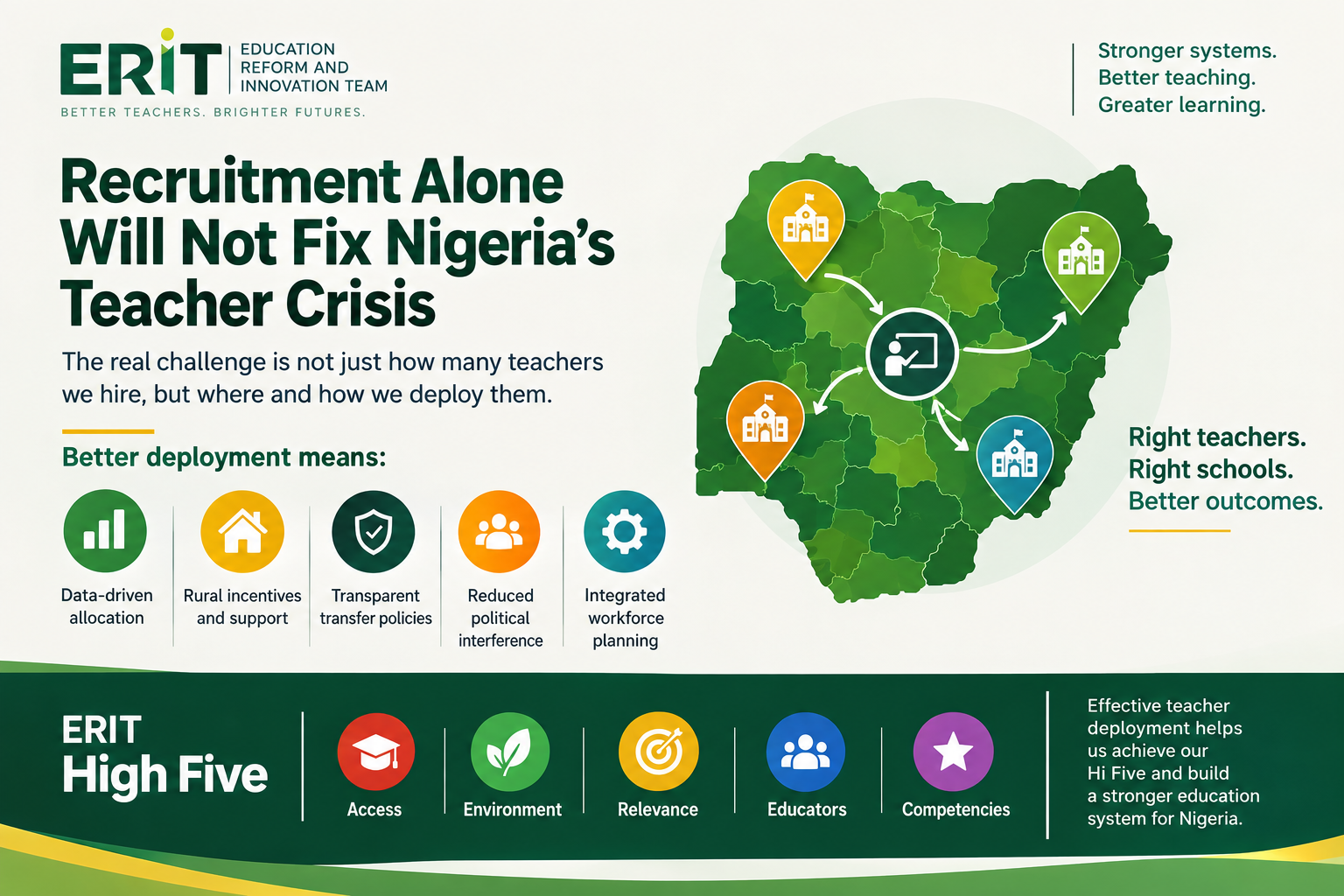
Every few months, we see headlines announcing the recruitment of thousands of new teachers. It sounds like progress.
But in too many rural communities, one teacher still handles multiple classes. Some secondary schools still have no physics teacher. Others lack mathematics or English specialists. Meanwhile, in certain urban centres, staffrooms are full.
This is the uncomfortable truth: Nigeria does not just have a teacher shortage problem. It has a teacher deployment problem.
The Real Issue: Maldistribution
On paper, pupil–teacher ratios may look reasonable. But averages hide inequality.
Data from the Universal Basic Education Commission and the National Bureau of Statistics show persistent disparities between urban and rural schools across states.
The pattern is familiar:
- Teachers prefer urban postings
- Administrators face pressure to approve transfers
- Influential actors intervene
- Rural schools are left understaffed
The result?
Surplus in some schools.
Acute shortage in others.
Same state. Same payroll. Very different realities.
Recruitment without rational deployment simply redistributes imbalance.
Why Recruitment Alone Fails
When governments focus exclusively on hiring more teachers, three things happen:
1. The Wage Bill Grows, But Inequality Persists
States expand salary commitments without guaranteeing that underserved schools benefit. Public expenditure rises. Learning outcomes remain uneven.
That is fiscal inefficiency.
2. Rural Learners Fall Further Behind
In many rural schools:
- Teachers manage multi-grade classrooms
- Core subjects go untaught
- Instructional time shrinks
- Student motivation drops
Education becomes determined by geography.
And that is an equity failure.
3. Subject Imbalance Continues
We recruit more teachers, but not necessarily in the subjects where they are most needed.
STEM shortages persist. Workforce planning remains weak. The system hires in bulk, but deploys without precision.
The outcome is predictable: numbers improve on paper, but classroom experience barely changes.
The Political Economy of Posting
Let’s confront the sensitive issue.
In many states, teacher deployment is not purely technical.
After recruitment:
- Teachers lobby for urban transfers
- Political actors intervene
- Administrative discretion overrides data
- Rules become negotiable
When posting becomes a function of influence rather than need, the system sends a signal: equity is optional.
That erodes trust, not just in policy, but in governance itself.
What Serious Reform Should Look Like
If we are committed to improving learning outcomes, deployment must be treated as a strategic lever, not an administrative afterthought.
Here are four reforms that matter:
1. Data-Driven Allocation
Teacher posting should be tied to:
- Enrolment figures
- Subject demand
- Defined pupil–teacher benchmarks
- Geographic hardship indices
Technology can minimize arbitrary decisions.
2. Structured Rural Incentives
Rural service cannot be punitive.
Make it professionally attractive through:
- Hardship allowances
- Housing support
- Accelerated promotion pathways
- Guaranteed transfer after defined tenure
Compulsion without incentives breeds resistance. Incentives with structure build stability.
3. Transparent Transfer Policies
Clear, published rules reduce manipulation. Scheduled transfer windows prevent constant movement. Enforcement restores credibility.
4. Integrated Workforce Planning
Recruitment quotas must align with:
- Demographic projections
- Subject shortages
- Retirement forecasts
- Curriculum reforms
Hiring and deployment must function as one coordinated system.
The Deeper Question
At its core, teacher maldistribution is not a staffing issue. It is a justice issue.
When urban schools are overstaffed while rural schools struggle, we institutionalize inequality.
Children’s educational futures become tied to their postcode.
No serious nation can accept that.
A Leadership Challenge
Nigeria needs more teachers.
But numbers alone will not solve the crisis.
The more important question is this:
Are the right teachers in the right schools, teaching the right subjects, where learners need them most?
Until deployment reform becomes as urgent as recruitment, we will continue celebrating impressive hiring figures while rural classrooms remain underserved.
It is time to shift the conversation from how many teachers we hire to where and how we deploy them.
That is where real reform begins.
Adeyemi Adedeji,
On behalf of the Education Reform and Innovation Team