
An Actionable Policy Framework for the Education Reform and Innovation Team (ERIT)
The recent abduction and prolonged captivity of school children and teachers in parts of Nigeria once again exposes a profound structural vulnerability within the nation’s education system. While security agencies often bear the responsibility for responding to such incidents, school safety cannot be treated solely as a military or law enforcement concern. It is fundamentally an education governance issue.
Schools cannot fulfil their mandate of teaching and learning where fear has replaced safety. Every school abduction undermines public confidence in education, disrupts learning, traumatizes children and teachers, and increases the likelihood of school dropout, particularly among girls and vulnerable learners. Protecting schools must therefore become an integral component of educational planning, management, and accountability.
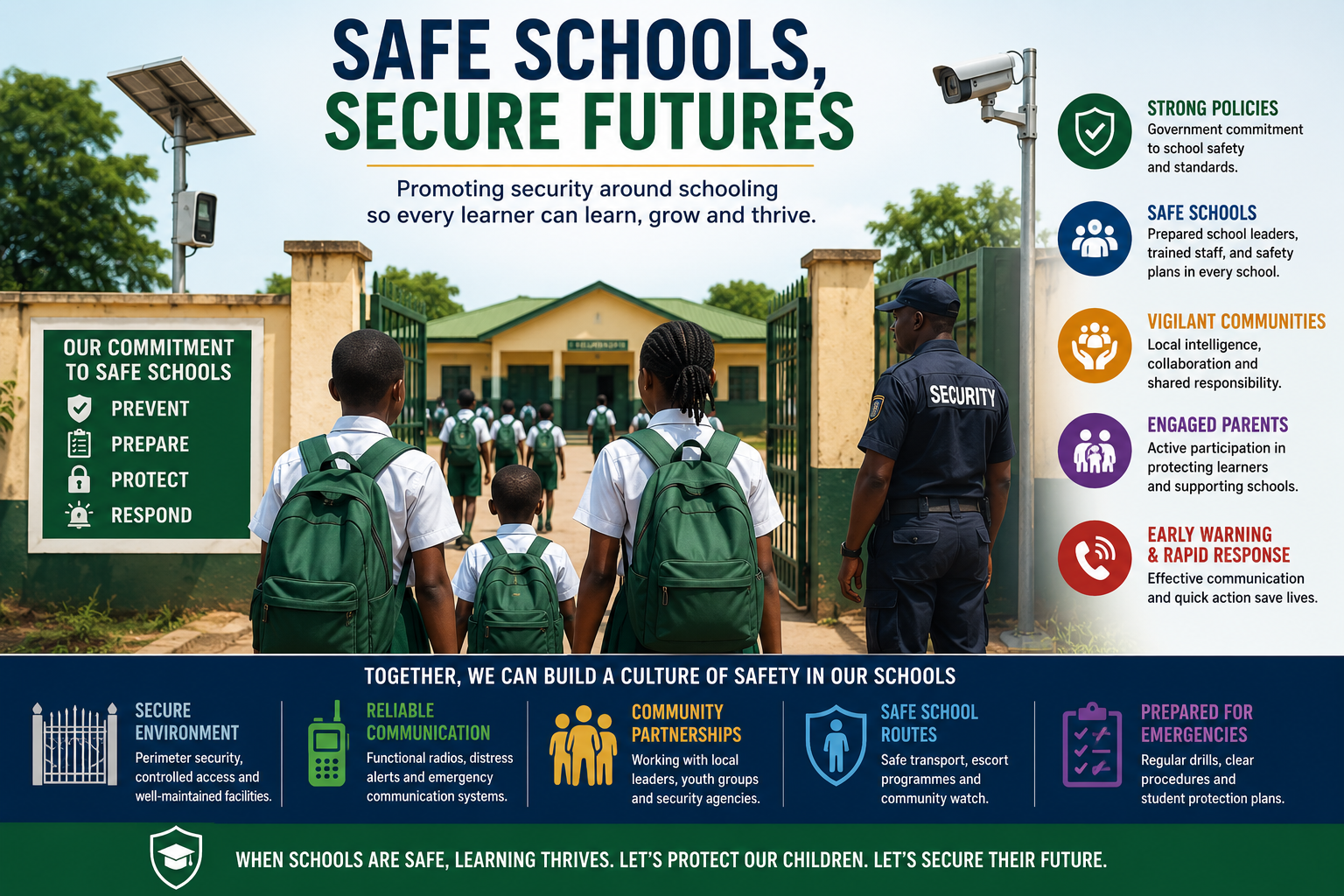
To reduce the risk of future attacks, Nigeria must move beyond reactive responses and establish a comprehensive system of prevention, preparedness, deterrence, and rapid response. This requires coordinated action across four critical stakeholder groups: government, school leaders, communities, and parents.
1. Government: Institutional Fortification and System-Level Security
Government bears the primary responsibility for creating an enabling environment in which schools can operate safely. This requires both strategic investment and regulatory oversight.
Comprehensive School Risk Mapping
Federal and state Ministries of Education should undertake a nationwide geospatial audit of schools, identifying institutions located near forests, border communities, conflict-prone areas, major transit routes, and other high-risk zones. Such mapping should inform differentiated security interventions based on risk profiles rather than a one-size-fits-all approach.
Off-Grid Emergency Communication Systems
Many vulnerable schools operate in areas with weak or non-existent telecommunications coverage. Governments should deploy solar-powered distress beacons, radio-based emergency systems, mesh-network communication devices, and other resilient technologies capable of transmitting alerts even when conventional mobile networks fail. The ability to communicate during the first minutes of an attack can significantly improve response outcomes.
Full Operationalization of the Safe Schools Initiative
Resources allocated to school safety should prioritize frontline protection measures rather than administrative expenditures. Funding should support local security infrastructure, community-based surveillance mechanisms, and the deployment of trained security personnel, including Forest Guards and other approved security structures, around vulnerable educational clusters.
Minimum School Security Standards
Governments should establish legally enforceable minimum safety standards for all schools. These standards should include perimeter protection, emergency communication systems, evacuation protocols, and access-control measures. Schools that fail to meet basic safety requirements should receive targeted support and, where necessary, temporary consolidation into safer locations until risks are mitigated.
Integrated School Safety Governance
School safety should be embedded within broader education sector planning. State education authorities should routinely monitor safety indicators alongside learning outcomes, teacher deployment, infrastructure quality, and school attendance data.
2. School Leaders: Operational Preparedness and Risk Management
School leaders serve as the first line of defence in protecting learners and staff. Their role extends beyond administration to proactive risk management.
Controlled Access and Environmental Design
Schools should adopt single-point-of-entry systems, maintain visitor registration procedures, and eliminate dense vegetation or visual obstructions around school perimeters. Physical environments should be designed to improve visibility and reduce opportunities for surprise attacks.
Early-Warning and Rapid Alert Mechanisms
Every school should maintain direct communication channels with nearby police stations, military formations, civil defence units, and accredited community security networks. School administrators should have access to silent alarm systems and emergency reporting protocols capable of triggering immediate response.
Crisis Preparedness and Simulation Exercises
Emergency preparedness should become a routine aspect of school management. Schools should conduct periodic drills covering shelter-in-place procedures, evacuation protocols, reunification processes, and emergency communication arrangements. During a crisis, trained responses save lives.
School Safety Committees
Each school should establish a safety committee comprising administrators, teachers, parent representatives, and community stakeholders responsible for overseeing preparedness plans and coordinating risk mitigation efforts.
3. Communities: Local Vigilance and Collective Responsibility
Communities are often the earliest source of intelligence and the first responders in rural environments. Their involvement is essential to effective school protection.
Joint Action Security Committees (JASC)
Communities should establish formal security committees comprising traditional rulers, youth groups, religious leaders, women leaders, local hunters, and other trusted stakeholders. These committees should coordinate surveillance efforts and maintain regular engagement with security agencies.
Community-Based Intelligence Networks
Farmers, hunters, transport operators, and local residents possess valuable knowledge of terrain, movement patterns, and unusual activities. Structured channels should be created to ensure that such intelligence is systematically shared with school authorities and security agencies.
Ownership of School Security
School safety must be viewed as a community responsibility rather than solely a government obligation. Communities should actively participate in monitoring school environments, supporting emergency response systems, and safeguarding educational assets.
Public Awareness and Social Mobilization
Regular awareness campaigns can help communities recognize emerging threats, report suspicious activities, and understand their role in protecting children and schools.
4. Parents: Organized Protection and Accountability
Parents are indispensable partners in ensuring learner safety. Their involvement should extend beyond enrolment and academic monitoring to active participation in school security arrangements.
Parent-Led Transit Cohorts
In vulnerable areas, parents should organize supervised group transportation systems, including walking buses, shared vehicles, and coordinated pick-up arrangements. Reducing isolated movement significantly lowers children’s exposure to risk.
Dynamic Security Communication Networks
Parents should participate in dedicated communication channels for sharing security-related information. SMS groups, radio networks, and verified messaging platforms can facilitate the rapid dissemination of alerts and situational updates.
Active Engagement with School Safety Structures
Parents should be represented on school safety committees and participate in periodic reviews of school security measures, emergency preparedness plans, and risk assessments.
Accountability and Advocacy
Parents can serve as powerful advocates for improved school safety standards by engaging school authorities, local governments, and policymakers on identified gaps and emerging concerns.
Strategic Mandate for ERIT
As the Education Reform and Innovation Team (ERIT), our role is not to provide armed security or conduct security operations. Rather, our comparative advantage lies in shaping policy, strengthening institutions, generating evidence, building capacity, and driving systemic reform.
School safety must become a core component of educational quality and school effectiveness. A school cannot be considered successful if learners are unable to access education safely.
To advance this agenda, ERIT will prioritize five strategic interventions.
1. Development of a School Safety Index Scorecard
ERIT will design and pilot a standardized School Safety Index Scorecard that assesses schools against key safety indicators, including infrastructure, emergency preparedness, communication systems, community engagement, governance structures, and crisis response capacity.
The scorecard will enable governments, school proprietors, and development partners to identify vulnerabilities, prioritize investments, and track improvements over time.
2. Evidence Generation and Policy Research
ERIT will conduct research into school safety challenges, emerging threats, and best practices from across Nigeria and comparable contexts. This evidence will support informed policymaking and resource allocation.
3. Capacity Building for School Leaders
ERIT will develop training programmes, toolkits, and guidance materials that strengthen the capacity of school leaders to manage safety risks, develop emergency plans, and coordinate local response mechanisms.
4. Policy Advocacy and Institutional Reform
ERIT will engage federal and state governments, legislators, development partners, and education stakeholders to promote the adoption of minimum school safety standards, sustainable financing mechanisms, and accountability frameworks for school protection.
5. Technology and Innovation for School Safety
ERIT will advocate for the deployment of resilient, off-grid communication technologies and other innovative solutions that enhance emergency response capabilities, particularly in remote and high-risk communities.
Conclusion
Protecting schools is not merely a security objective; it is an educational imperative. Every child has the right to learn in a safe environment, and every school should be equipped to prevent, withstand, and respond to security threats.
A sustainable solution to school abductions requires a whole-system approach in which government provides policy direction and resources, school leaders strengthen preparedness, communities contribute vigilance and intelligence, parents support protective measures, and reform organizations such as ERIT drive institutional change.
Only through such coordinated action can Nigeria secure the sanctity of learning and ensure that schools remain places of hope, opportunity, and safety for every learner.
By Adeyemi Adedeji
On behalf of the Education Reform and Innovation Team